
Recently I’ve encounter an error that was restarting the VMM service. As you know if the VMM service crashes the jobs that are currently running will fail. So I was experiencing Event ID 19999 in the VMM event log which was crashing the VMM service once or twice per day. This could be very annoying especially in a production environment where jobs are running all the time. Here is what is the exact error in VMM event log:
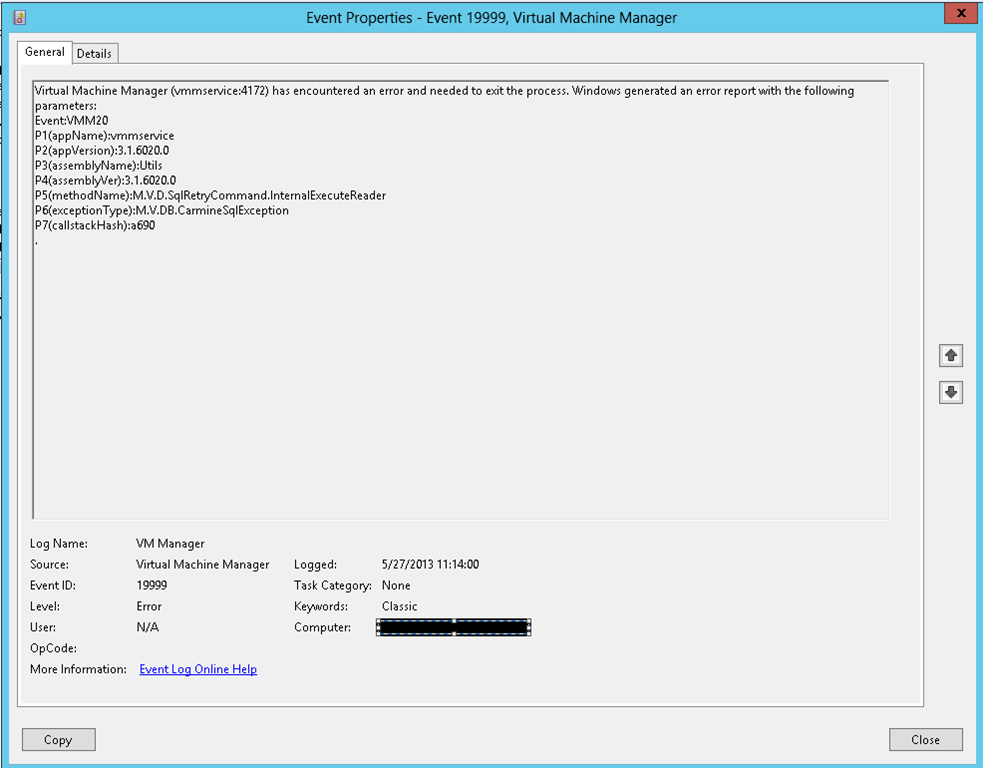
Log Name: VM Manager
Source: Virtual Machine Manager
Date: 5/27/2013 11:14:00
Event ID: 19999
Task Category: None
Level: Error
Keywords: Classic
User: N/A
Computer: vmm-server.contoso.com
Description:
Virtual Machine Manager (vmmservice:4172) has encountered an error and needed to exit the process. Windows generated an error report with the following parameters:
Event:VMM20
P1(appName):vmmservice
P2(appVersion):3.1.6020.0
P3(assemblyName):Utils
P4(assemblyVer):3.1.6020.0
P5(methodName):M.V.D.SqlRetryCommand.InternalExecuteReader
P6(exceptionType):M.V.DB.CarmineSqlException
P7(callstackHash):a690
.
When you look at the error you could not find any hint what exactly was causing the issue. Pretty nasty error so it was time for some deep troubleshooting. This could be achieved by enabling debug logging for SCVMM 2012 SP1 and it is simple and easy. It is all described in knowledge base article: http://support.microsoft.com/kb/2801185. As I couldn’t reproduce the issue at a specific time I’ve just enabled the trace for 24 hours. From time to time I’ve monitored the VMM event log to if the error has appeared. When I saw that the error appeared again I’ve stopped the trace. Remember the exact time when the error was logged in the VMM event log and started to look for something suspicious on the debug log around the same time of the error. And I’ve found the cause of the restart in the following lines:
[0]104C.1370::2013-05-27 11:14:00.909 [Microsoft-VirtualMachineManager-Debug]4,1,Catalog.cs,898,!!! System.Data.SqlClient.SqlException (0x80131904): Cannot execute as the database principal because the principal “DOMAIN\ACCOUNT” does not exist, this type of principal cannot be impersonated, or you do not have permission. at System.Data.SqlClient.SqlConnection.OnError(SqlException exception, Boolean breakConnection, Action`1 wrapCloseInAction) at System.Data.SqlClient.TdsParser.ThrowExceptionAndWarning(TdsParserStateObject stateObj, Boolean callerHasConnectionLock, Boolean asyncClose) at System.Data.SqlClient.TdsParser.TryRun(RunBehavior runBehavior, SqlCommand cmdHandler, SqlDataReader dataStream, BulkCopySimpleResultSet bulkCopyHandler, TdsParserStateObject stateObj, Boolean& dataReady) at System.Data.SqlClient.SqlDataReader.TryConsumeMetaData() at System.Data.SqlClient.SqlDataReader.get_MetaData() at System.Data.SqlClient.SqlCommand.FinishExecuteReader(SqlDataReader ds, RunBehavior runBehavior, String resetOptionsString) at System.Data.SqlClient.SqlCommand.RunExecuteReaderTds(CommandBehavior cmdBehavior, RunBehavior runBehavior, Boolean returnStream, Boolean async, Int32 timeout, Task& task, Boolean asyncWrite) at System.Data.SqlClient.SqlCommand.RunExecuteReader(CommandBehavior cmdBehavior, RunBehavior runBehavior, Boolean returnStream, String method, TaskCompletionSource`1 completion, Int32 timeout, Task& task, Boolean asyncWrite) at System.Data.SqlClient.SqlCommand.RunExecuteReader(CommandBehavior cmdBehavior, RunBehavior runBehavior, Boolean returnStream, String method) at System.Data.SqlClient.SqlCommand.ExecuteReader(CommandBehavior behavior, String method) at System.Data.SqlClient.SqlCommand.ExecuteReader(CommandBehavior behavior) at Microsoft.VirtualManager.DB.SqlRetryCommand.InternalExecuteReader() ClientConnectionId:847489e7-ea6f-47fe-807f-07cf880a5cef Error = 15517 Index #0 Source: .Net SqlClient Data Provider Number: 15517 State: 1 Class: 16 Server: vmm-server.contoso.com\VMMSQLINSTANCE,<PORT> Message: Cannot execute as the database principal because the principal “DOMAIN\ACCOUNT” does not exist, this type of principal cannot be impersonated, or you do not have permission. Procedure: prc_RBS_UserRole_GetAllByUser Line: 13 FileName:; Method:ExecuteReader(); lineNo:0; ilOffset:7. FileName:; Method:<ReadUserRolesLight>b__30(); lineNo:0; ilOffset:12. FileName:; Method:HandleReadErrors(); lineNo:0; ilOffset:8. FileName:; Method:ReadUserRolesLight(); lineNo:0; ilOffset:13. FileName:; Method:GetAllUserRoles(); lineNo:0; ilOffset:20. FileName:; Method:GetRolesForUser(); lineNo:0; ilOffset:53. FileName:; Method:.ctor(); lineNo:0; ilOffset:145. FileName:; Method:CreateMicrosoft.VirtualManager.Engine.Remoting.ClientConnection(); lineNo:0; ilOffset:-1. FileName:; Method:GetServiceInstance(); lineNo:0; ilOffset:103. FileName:; Method:EnsureServiceInstance(); lineNo:0; ilOffset:60. FileName:; Method:ProcessMessage41(); lineNo:0; ilOffset:50. FileName:; Method:ProcessMessage31(); lineNo:0; ilOffset:198. FileName:; Method:Process(); lineNo:0; ilOffset:98. FileName:; Method:DispatchAndReleasePump(); lineNo:0; ilOffset:598. FileName:; Method:HandleRequest(); lineNo:0; ilOffset:241. FileName:; Method:AsyncMessagePump(); lineNo:0; ilOffset:57. FileName:; Method:UnhandledExceptionFrame(); lineNo:0; ilOffset:0. FileName:; Method:Complete(); lineNo:0; ilOffset:194. FileName:; Method:OnReceive(); lineNo:0; ilOffset:75. FileName:; Method:UnhandledExceptionFrame(); lineNo:0; ilOffset:0. FileName:; Method:Complete(); lineNo:0; ilOffset:194. FileName:; Method:OnReceiveComplete(); lineNo:0; ilOffset:43. FileName:; Method:OnAsyncReadComplete(); lineNo:0; ilOffset:188. FileName:; Method:UnhandledExceptionFrame(); lineNo:0; ilOffset:0. FileName:; Method:Complete(); lineNo:0; ilOffset:62. FileName:; Method:ProcessFrameBody(); lineNo:0; ilOffset:112. FileName:; Method:ReadCallback(); lineNo:0; ilOffset:104. FileName:; Method:CheckCompletionBeforeNextRead(); lineNo:0; ilOffset:93. FileName:; Method:ReadCallback(); lineNo:0; ilOffset:41. FileName:; Method:Complete(); lineNo:0; ilOffset:194. FileName:; Method:OnAsyncIOComplete(); lineNo:0; ilOffset:38. FileName:; Method:OnReceiveAsync(); lineNo:0; ilOffset:87. FileName:; Method:FinishOperationSuccess(); lineNo:0; ilOffset:1483. FileName:; Method:CompletionPortCallback(); lineNo:0; ilOffset:16. FileName:; Method:PerformIOCompletionCallback(); lineNo:0; ilOffset:60. ,{00000000-0000-0000-0000-000000000000}
[0]104C.1370::2013-05-27 11:14:00.909 [Microsoft-VirtualMachineManager-Debug]4,1,Catalog.cs,950,No retry on exception System.Data.SqlClient.SqlException (0x80131904): Cannot execute as the database principal because the principal “DOMAIN\ACCOUNT” does not exist, this type of principal cannot be impersonated, or you do not have permission. at System.Data.SqlClient.SqlConnection.OnError(SqlException exception, Boolean breakConnection, Action`1 wrapCloseInAction) at System.Data.SqlClient.TdsParser.ThrowExceptionAndWarning(TdsParserStateObject stateObj, Boolean callerHasConnectionLock, Boolean asyncClose) at System.Data.SqlClient.TdsParser.TryRun(RunBehavior runBehavior, SqlCommand cmdHandler, SqlDataReader dataStream, BulkCopySimpleResultSet bulkCopyHandler, TdsParserStateObject stateObj, Boolean& dataReady) at System.Data.SqlClient.SqlDataReader.TryConsumeMetaData() at System.Data.SqlClient.SqlDataReader.get_MetaData() at System.Data.SqlClient.SqlCommand.FinishExecuteReader(SqlDataReader ds, RunBehavior runBehavior, String resetOptionsString) at System.Data.SqlClient.SqlCommand.RunExecuteReaderTds(CommandBehavior cmdBehavior, RunBehavior runBehavior, Boolean returnStream, Boolean async, Int32 timeout, Task& task, Boolean asyncWrite) at System.Data.SqlClient.SqlCommand.RunExecuteReader(CommandBehavior cmdBehavior, RunBehavior runBehavior, Boolean returnStream, String method, TaskCompletionSource`1 completion, Int32 timeout, Task& task, Boolean asyncWrite) at System.Data.SqlClient.SqlCommand.RunExecuteReader(CommandBehavior cmdBehavior, RunBehavior runBehavior, Boolean returnStream, String method) at System.Data.SqlClient.SqlCommand.ExecuteReader(CommandBehavior behavior, String method) at System.Data.SqlClient.SqlCommand.ExecuteReader(CommandBehavior behavior) at Microsoft.VirtualManager.DB.SqlRetryCommand.InternalExecuteReader() ClientConnectionId:847489e7-ea6f-47fe-807f-07cf880a5cef Error = 15517 Index #0 Source: .Net SqlClient Data Provider Number: 15517 State: 1 Class: 16 Server: vmm-server.contoso.com\VMMSQLINSTANCE,<PORT> Message: Cannot execute as the database principal because the principal “DOMAIN\ACCOUNT” does not exist, this type of principal cannot be impersonated, or you do not have permission. Procedure: prc_RBS_UserRole_GetAllByUser Line: 13 FileName:; Method:ExecuteReader(); lineNo:0; ilOffset:7. FileName:; Method:<ReadUserRolesLight>b__30(); lineNo:0; ilOffset:12. FileName:; Method:HandleReadErrors(); lineNo:0; ilOffset:8. FileName:; Method:ReadUserRolesLight(); lineNo:0; ilOffset:13. FileName:; Method:GetAllUserRoles(); lineNo:0; ilOffset:20. FileName:; Method:GetRolesForUser(); lineNo:0; ilOffset:53. FileName:; Method:.ctor(); lineNo:0; ilOffset:145. FileName:; Method:CreateMicrosoft.VirtualManager.Engine.Remoting.ClientConnection(); lineNo:0; ilOffset:-1. FileName:; Method:GetServiceInstance(); lineNo:0; ilOffset:103. FileName:; Method:EnsureServiceInstance(); lineNo:0; ilOffset:60. FileName:; Method:ProcessMessage41(); lineNo:0; ilOffset:50. FileName:; Method:ProcessMessage31(); lineNo:0; ilOffset:198. FileName:; Method:Process(); lineNo:0; ilOffset:98. FileName:; Method:DispatchAndReleasePump(); lineNo:0; ilOffset:598. FileName:; Method:HandleRequest(); lineNo:0; ilOffset:241. FileName:; Method:AsyncMessagePump(); lineNo:0; ilOffset:57. FileName:; Method:UnhandledExceptionFrame(); lineNo:0; ilOffset:0. FileName:; Method:Complete(); lineNo:0; ilOffset:194. FileName:; Method:OnReceive(); lineNo:0; ilOffset:75. FileName:; Method:UnhandledExceptionFrame(); lineNo:0; ilOffset:0. FileName:; Method:Complete(); lineNo:0; ilOffset:194. FileName:; Method:OnReceiveComplete(); lineNo:0; ilOffset:43. FileName:; Method:OnAsyncReadComplete(); lineNo:0; ilOffset:188. FileName:; Method:UnhandledExceptionFrame(); lineNo:0; ilOffset:0. FileName:; Method:Complete(); lineNo:0; ilOffset:62. FileName:; Method:ProcessFrameBody(); lineNo:0; ilOffset:112. FileName:; Method:ReadCallback(); lineNo:0; ilOffset:104. FileName:; Method:CheckCompletionBeforeNextRead(); lineNo:0; ilOffset:93. FileName:; Method:ReadCallback(); lineNo:0; ilOffset:41. FileName:; Method:Complete(); lineNo:0; ilOffset:194. FileName:; Method:OnAsyncIOComplete(); lineNo:0; ilOffset:38. FileName:; Method:OnReceiveAsync(); lineNo:0; ilOffset:87. FileName:; Method:FinishOperationSuccess(); lineNo:0; ilOffset:1483. FileName:; Method:CompletionPortCallback(); lineNo:0; ilOffset:16. FileName:; Method:PerformIOCompletionCallback(); lineNo:0; ilOffset:60. ,{00000000-0000-0000-0000-000000000000}
[0]104C.1370::2013-05-27 11:14:00.919 [Microsoft-VirtualMachineManager-Debug]4,2,ServiceHost.cs,103,Entering ServiceHost.Abort(),{00000000-0000-0000-0000-000000000000}
[0]104C.1370::2013-05-27 11:14:00.919 [Microsoft-VirtualMachineManager-Debug]4,2,ServiceHost.cs,107,Aborting service…,{00000000-0000-0000-0000-000000000000}
[0]104C.1370::2013-05-27 11:14:00.920 [Microsoft-VirtualMachineManager-Debug]18,2,ClientConnection.cs,110,Closing client connection: uuid:28e20707-2e11-4765-a801-825a15287e37;id=1,{00000000-0000-0000-0000-000000000000}
The text in blue are values that will be different in your environment. The text in red is the reason why the VMM service was restarting and the text in green shows the restarting of the VMM service.
The account that was causing this was my Operations Manager account that I was using for SCOM-VMM integration. This is the same account that I use for Default Action Account in SCOM. It has all the needed rights and even has SA rights on the SQL instance where VMM database is located. Integration with VMM and monitoring was also working without errors. But even with such rights this account was giving an error that cannot logon to the VMM database.
The first thing that I’ve tried is to remove the SCOM-VMM integration and than create it again. I’ve done it but the error was still occurring and the VMM service was restarting.
The second thing I’ve done is to logon on the SQL instance where VMM database is and add the account in question to the security in SQL with rights to login.
After my second solution I’ve been running my VMM server more than 24 hours and the error still hasn’t appear.
Update 1: I’ve spoke to early and my second solution also didn’t worked. I am working on resolving it and will post a solution as soon as I have success.
Update 2: I think I’ve finally found a solution as since my last actions I haven’t gotten the error and this was 3 days ago. So here are the actions that I have done:
1. Removed the VMM – SCOM integration from VMM.
2. Created a new account for the SCOM – VMM integration. Even though I am creating a new account the cause of the issue is not in the account.
3. Removed the VMM Run As account from SCOM. If you remove the integration from VMM the Run As account is not deleted. In fact if you create the integration with new account in SCOM the Run As account stays the same that was entered during the first creation of the integration.
4. Gave the new account appropriate permissions – member of Administrator role in VMM.
5. Created the SCOM-VMM integration again with the new account.
If you stumble upon on this issue I hope these steps will help you.
Software I’ve used:
- Windows Server 2012
- SCVMM 2012 SP1 UR2
- SCOM 2012 SP1 UR2
- SQL 2012 SP1
 .
. Cloud Administrator in Azure World